FAQ
On this page you'll find answers to frequently asked questions
SiamWellTest
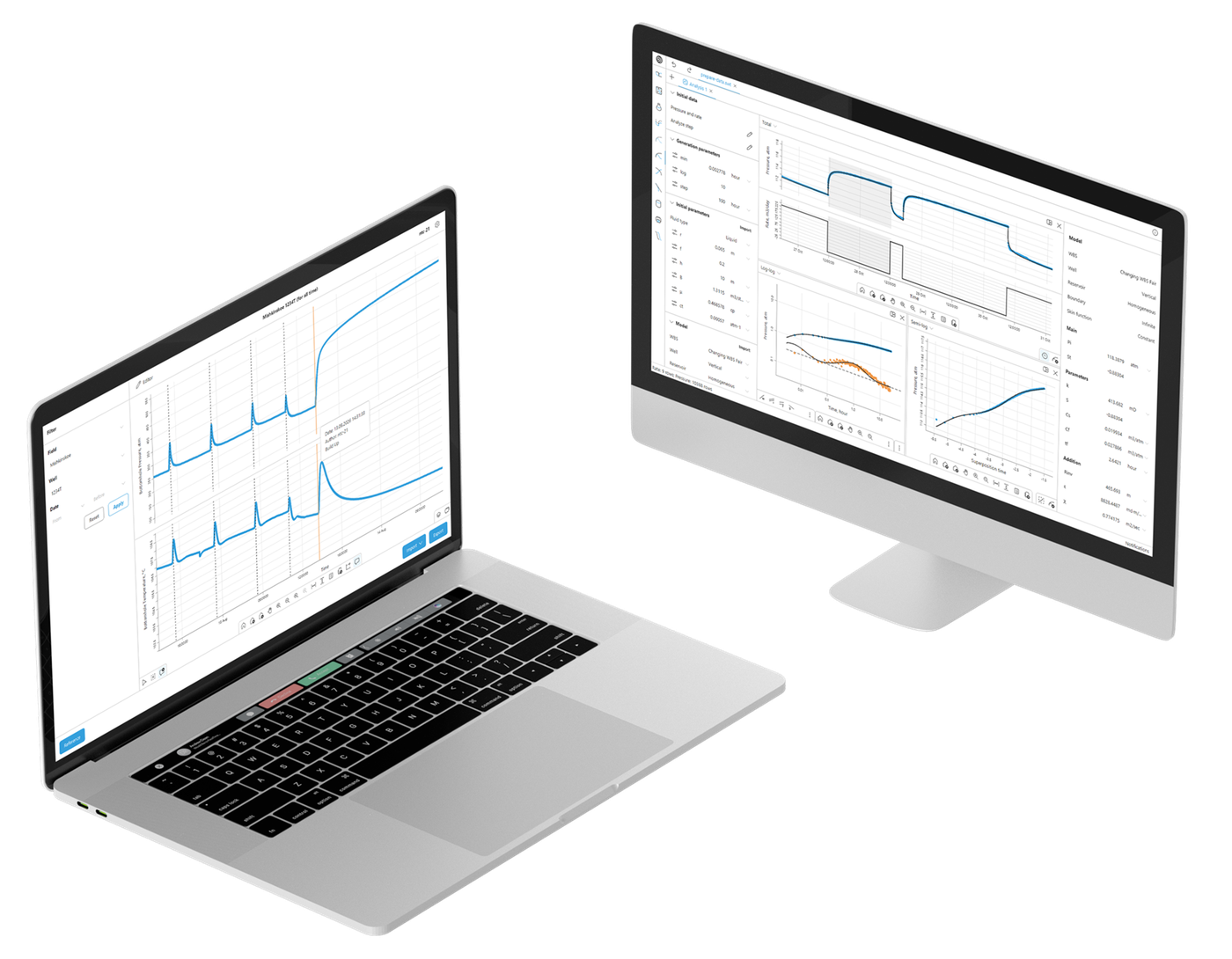
32 questionsIt's a professional software suite for preparing, analyzing, and interpreting hydrodynamic and gas-dynamic well tests (PTA) and production analysis (RTA).
Yes, SiamWellTest is included in the Russian software registry — an officially confirmed domestic product suitable for procurement under import substitution requirements.
A well test is a set of activities for studying the near-wellbore zone, reservoir properties, and its energy state. It's one of the most accessible and reliable data sources for field development design and management.
Data digitizing, well test interpretation, production analysis, test design, reservoir and well parameter estimation, boundary and fault detection, and well interference analysis.
Reservoir energy state, reservoir flow-capacitance properties, wellbore and fracture geometry, presence and distance to boundaries and faults, and near-wellbore zone condition.
These are well testing methods that involve shutting in the well (buildup, drawdown) or changing its flow regime (multi-rate testing).
A modern data analysis method based on studying long-term pressure and rate telemetry records. It allows determining reservoir and well performance characteristics without shutting in the well.
A way to predict well and reservoir behavior using a combination of analytical equations — for the wellbore, reservoir, and boundary conditions. It's based on proven solutions published in the scientific literature. Suitable for quick parameter estimation thanks to high calculation speed.
Another way to predict system behavior, but based on numerical solution of the equation system and grid modeling. A more flexible and customizable solution, but more time- and resource-intensive to calculate. Usually applied after the analytical estimate, to refine the results.
Well test interpretation is performed at specific pressures and temperatures, and fluid and reservoir properties depend significantly on these conditions. That's why it's important to accurately calculate fluid PVT properties before each test — otherwise the interpretation results will be distorted.
Yes, the suite handles both oil and gas wells equally well — for gas wells, the pseudo-pressure function is used, allowing the same equations to be applied.
Yes, analytical modeling has an interference mode for this, and numerical modeling supports complex maps with multiple interference sources by default.
There's a comparison module for this: you can compare raw gauge data, diagnostic plots, and analysis results in tabular form.
We verify the models at several levels: we cross-check the results of analytical and numerical calculations against each other, and we test them on benchmark cases against recognized industry-standard software. The deviation from the benchmark is minimal — in the vast majority of cases the results match with high accuracy.
On the same benchmark cases, SiamWellTest calculates analytical and numerical models 1–5 times faster than the benchmark software.
Calculation time depends on the number of objects in the model — from a few seconds to a few minutes for large, complex models.
Yes, a multi-level undo/redo stack is implemented to protect against mistakes in all modules.
Yes, direct import from Kappa software (Saphir, Topaze) is supported, starting from 5th-generation files. If you have files from an older version, automatic loading won't work — but we can convert such files as part of service support in a short time.
Yes, the application has a flexible unit system built in. Units can be set as default, specified during data import, or changed anywhere in the interface.
Yes — SiamWellTest is modular: we'll assemble and configure exactly the set of tools you need and calculate the price for that configuration.
Three options: a standalone application with local installation; a client with a local license server; a client with a subscription to cloud computing.
Via a hardware USB dongle or a digital license file.
Yes, the standalone build works without an internet connection — on a local PC, with a physical dongle or a digital license.
Yes, there's a version with online computing on our compute servers for this.
Yes, if you choose the "standalone" or "local license server" deployment type.
Nothing — all data is stored in a single unified file format, and opening it isn't tied to the license type.
Windows, Linux, and macOS are supported — it's a cross-platform desktop solution that can be deployed on practically any workstation.
A 4-core processor at 2.5 GHz or higher and 8 GB of RAM is enough for comfortable work, including numerical modeling, with room to spare.
Yes, as part of technical support we develop customized integration modules with the customer's corporate systems.
Yes, as part of support we can develop a report in any form — it will be exported with the click of a button right from the reports module.
Under a technical support agreement, the customer gets access to new versions as soon as they're released, directly in their personal account.
If the specialist has worked with similar software before, they'll be navigating SiamWellTest comfortably in about a week. And after a month of use, in our experience, users no longer want to go back to their previous software.
SiamDataSpectrum
21 questionsA high-performance platform for centralized storage, aggregation, and visualization of time-series data and industrial telemetry.
It eliminates fragmented telemetry storage across files and programs: it stores everything in one place, provides fast access for viewing, and allows flexible data export for any purpose.
The platform is designed for 10+ years of history and can serve more than 1,000 objects, visualizing billions of data points without delay.
Pre-aggregation of data. We sacrifice a small amount of loading time and storage volume in exchange for maximum viewing and export speed.
Loading a day's worth of data takes seconds. Data for several weeks across several wells loads in tens of seconds. Multi-year, large archives — in minutes.
No — we store the original data so that any information can be recovered from it if needed, including data that didn't make it into the system. All data points are preserved without exception, and you can always export data in its original form.
Arbitrary tabular and text data, as well as binary formats from SIAM equipment (DAT, DBF).
There are no fixed data types built into the system — you can create your own series for any type of telemetry and load the data you need into them.
Yes, there's batch loading for this: you select or configure a template, and all files are loaded at once according to it.
Yes, there's a consolidated loading mode for this: data is pulled from one file but assigned to different objects.
To synchronize heterogeneous data to a common export grid, we use a flexible interpolation system — the user chooses how the system should behave when points don't align by timestamp.
Yes, you can choose any thinning depth — the flexible interpolation system will assemble the final synchronized table. Export is available in Excel and CSV.
The application has a flexible unit system built in — Russian, international (SI), and other popular field units. Default units are configured in the profile, and they can always be switched during import, export, on charts, and in input fields.
The measurement is detached from one object — essentially a deletion procedure with segment recalculation — and at the same moment added to the new object, which also triggers segment rebuilding. If the measurement was edited before that, it's carried over along with all the changes.
User rights are separated by role — viewing, uploading, editing, and working with reference directories. Data transfer is protected by SSL/TLS encryption.
Full backups are kept: yearly — for 3 years, monthly — for 12 months, a full backup is made once a week, an incremental one — daily. In an emergency, data can be restored from backups with minimal loss.
On-Premise: installed on the customer's local servers or private cloud — for maximum control over security. SaaS: a managed service maintained by Siam Geotest specialists.
Yes — with On-Premise deployment, the server is installed on the customer's side, and clients also work in a local, fully isolated environment.
We deploy a temporary server for the customer, conduct a training session on working with the product using their data, and provide support throughout the trial period.
Yes: full technical support, integration with the customer's internal systems, and regular updates — we respond promptly to user requests and suggestions.
Contact us any convenient way — we'll review your request promptly and get in touch.
SiamEngy
15 questionsA free mobile app for oil and gas professionals, combining interactive formulas, a unit converter, and reference information.
For field engineers, drillers, process engineers, geologists, supervisors, and oil and gas university students.
The app is completely free (₽0) — no subscriptions, ads, or hidden charges.
The app is available for download on Google Play (Android) and the App Store (iOS).
No, the app is fully autonomous and works offline.
The equation is calculated directly — like a regular calculator — when all parameters except the one you're looking for are known. To find any other parameter of a formula, a built-in numerical optimizer picks its value so that the direct calculation matches the entered data — there's no need to manually rearrange the equation.
The app automatically checks for convergence: if the result of a reverse calculation isn't confirmed by a direct check, you'll see a warning. The same applies if a parameter has several possible values — the solver will warn you that the solution isn't unique.
Yes, it has instant search built in across all formulas and reference articles.
No, the app is lightweight, optimized, and takes up about 60 MB of storage.
The functionality is completely identical — the app is cross-platform and released on both platforms simultaneously, with identical content.
Absolutely — one of the app's missions is passing knowledge on to the next generation of engineers.
Yes, the team regularly ships updates with new formulas and improvements based on store reviews and support requests.
Write to our support team and describe it — we'll consider the suggestion, and there's a good chance it'll make it into one of the upcoming updates.
It's not a priority right now, but we're tracking user requests — if demand becomes significant, we'll definitely consider such a version.
We publish the most up-to-date information on our blog on the website.
General
15 questionsThe company develops specialized software for oil and gas engineers: solving hydrodynamics problems, helping analyze field data, and managing field development.
Creating modern, industrial-grade digital tools at the intersection of deep engineering expertise and IT technology, to automate the work of oil and gas professionals.
Yes, all products are developed in Russia, independent of foreign technology stacks, and support running on domestic Linux operating systems.
Yes, we also work with organizations outside Russia — we provide demo versions and full licenses for both production tasks and training.
Yes — submit a request, and we'll flexibly tailor the format to your case, from a demonstration on a test dataset to a full pilot with loading and processing your actual data.
Yes, temporary, fully functional demo licenses are provided upon request.
The products have a built-in interactive reference guide, and consultations and implementation support are available. On request from companies or individuals, we also run product demonstrations and training courses for new users.
Yes, we provide our commercial products free of charge to universities and educational institutions under educational licenses for teaching purposes. We consider individual requests from students and faculty on a case-by-case basis.
On the company's official blog, where we publish release announcements, technical deep-dives, and usage examples.
Yes, the company develops custom integration modules, adapts reports, and extends functionality to meet a specific customer's requirements.
Write to support and describe the task — we'll discuss it with you. If it makes sense to implement the solution, we'll scope it as a separate customization and agree on a timeline.
Company specialists support the entire process — from installation and setup on the customer's infrastructure to user training and handover into operation.
Critical incidents are our priority: such requests are handled out of turn, and our best specialists are engaged immediately.
Contact technical support — we'll promptly help arrange a replacement dongle.
We maintain a log of bugs and improvement requests. It's currently private, but we plan to make it public in the near future.
No results found
Try adjusting your search or choose a different category.
Support
Didn't find the answer to your question?
Contact support and we'll help you out